Together, Installing the Executive Intelligence That Unseats Your Competition
The AND NEW origin story.
Sit through four AI consultancy pitches in a row and you will hear the same pitch four times.
The words change slightly. The deck changes slightly. The accent changes. But the offer is identical: tools. A chatbot for your front desk. Automation for your back office. A dashboard for your reports. A cost-cutting instrument wearing a nicer suit. Each firm swears its tools are smarter, its models newer, its integrations deeper. The CEO at the head of the table nods politely and thinks the thought no one says out loud: if everyone sells the same thing, the only thing left to compare is price.
That is the AI services market right now. Ninety-five percent of it, anyway. Firms selling tools first, decisions nowhere. Tools in search of decisions.
It is a category error, and it is expensive for everyone except the vendors. The buyer buys a chatbot and discovers nobody decided what the chatbot is for. The automation arrives and the process it automates was never worth doing. The dashboard glows with numbers nobody acts on. Each tool works. None of them matter. And the consultancy, having installed software, declares victory and invoices.
Here is the thing nobody in those four pitch meetings will say: the tools were never the problem. The decisions were. A company that cannot decide cannot be saved by software. A company that can decide does not need much software at all.
This paper is about the five percent. It is about what we put on, what we stand for, and which end of the problem we start from.
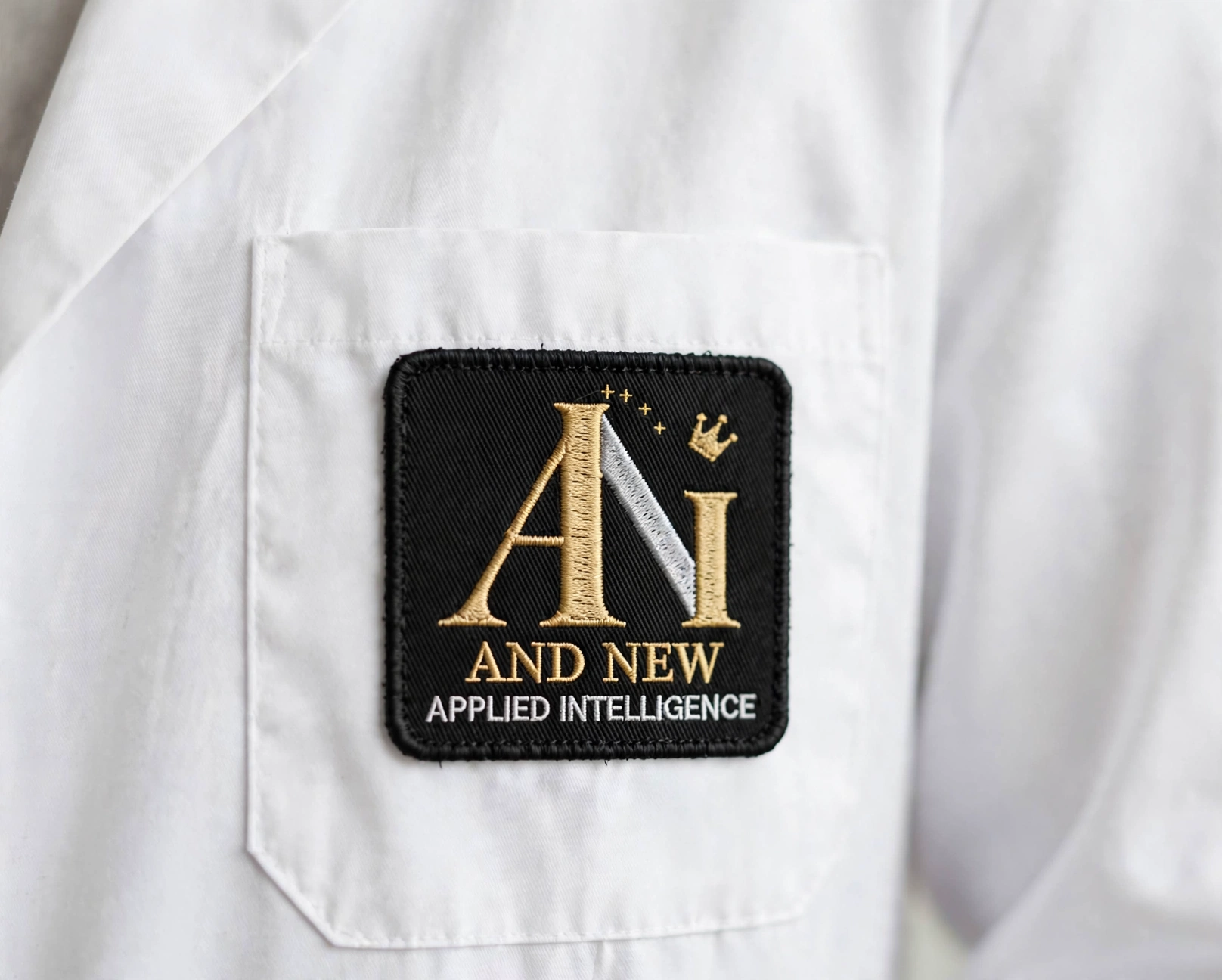
The man in our videos wears a crisp white lab coat. This is not a costume. It is a uniform, and uniforms tell you what someone does all day.
A lab coat is the uniform of someone who works on things that matter. It says precision, rigor, experimentation. It says the wearer is in the lab building, not on a stage pitching. Scientists wear white coats because the work is serious and the results have to be real. We wear one for the same reason.
On the left breast pocket sits a black twill patch. It carries one thing: the exact logo. Never redrawn, never reinterpreted, never improved.
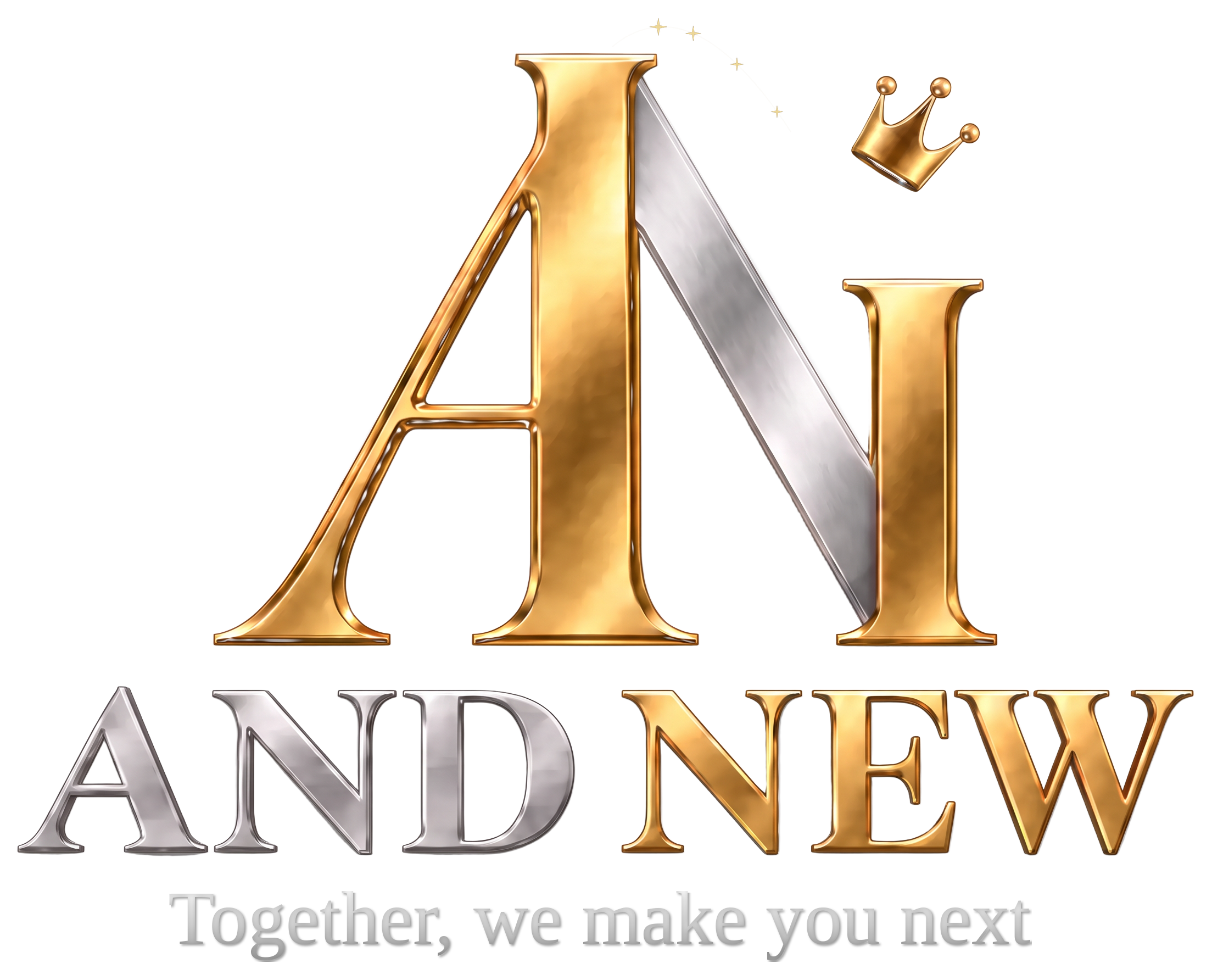
The logo is a small machine with several moving parts, and every part means something.
The monogram is gold, and it reads "AN" up close and "AI" at a distance. That double reading is the company's biography in two letters. AI-born: the firm was bootstrapped through maximal use of AI, built the way it advises. Market-forged: it exists because the market demanded it, not because a business plan imagined it. Up close you see the name. Step back and you see what made it.
A silver diagonal bar cuts through the N, part of the letter itself, because intelligence here is structural, not decorative. It is in the bones of the thing.
Above the monogram sits one gold crown, and the crown has a story. In the company's animation, the crown starts resting on the A. Then comes the ring announcer's moment, the Bruce Buffer moment: "Aaaand... NEW!" And the crown jumps to dot the i. Coronation and punctuation in a single move. The tagline lands with it: "Together, we make you next."
But watch where the crown travels, because the journey is the whole company in one gesture. It begins on the high perch, the big pedestal of the A: the incumbents, the established order, the ones who have sat in the seat so long they mistake it for property. Then it moves. And it lands on the little pedestal, the dot of the i, the smallest mark in the entire logo.
Four things ride with that crown. Empowerment: the crown is bestowed, not seized. It is placed deliberately on a new head, which is what installation means. Succession: the seat changes hands. The old holder is not reformed, not outcompeted on points. The throne passes. Movement: the crown is never at rest. Markets do not stand still, and neither does power; a crown that cannot move is a museum piece. The underdog: the little pedestal was the destination all along. The small mark, the overlooked one, the company everyone counted out, receives the crown. That is who we partner with. That is what we do to the order of things.
Trailing behind is the original star trail, exactly as drawn, because some things you do not touch.
Under the mark, in gold: AND NEW. And under that, in silver-white: APPLIED INTELLIGENCE.
Two notes about those words. First, the letters "AI" appear nowhere else on the site. Nowhere. That is deliberate. AI is the water, not the label. Fish do not hold meetings about water. We do not plaster the acronym across everything we own, because the technology is the medium we work in, not the message. The one place it appears is inside the monogram itself, where you have to look twice to see it. That is the correct proportion.
Second, the descriptor. We considered "Applied Innovations" and rejected it. It is generic and crowded, a phrase a hundred labs and consultancies already wear. "Applied Intelligence" won because it says what we do in two words: intelligence, put to work. Human judgment fused with AI, analytics, data, and automation. Information turned into decisions, decisions turned into executed action. The gap between insight and measurable outcome, closed.
We are under no illusion that the phrase is ours alone. Accenture uses it. FICO uses it. Universities use it. On its own it is descriptive, shared, crowded. That is precisely why our identity is not the phrase. It is the composite, all three together: the AND NEW name, the distinctive AN/AI mark, and Applied Intelligence as the descriptor. Any one of them alone is a word. All three together are a company.
AND NEW has no customers. It has no products. It has partners.
This is not wordplay. The words "customer" and "product" are banned from our literature, and the ban is enforced, because the words describe a relationship we refuse to have.
A product sits on a shelf. A partner gets in the ring.
"Customer" describes someone who buys a thing and walks away. "Product" describes the thing that sits there, inert, waiting to be bought. Neither word survives contact with what we actually do, which is stand next to a leadership team and install a capability they did not have. You cannot install anything in a customer. You can only install it in a partner, because installation requires access, trust, and shared stakes. A vendor ships. A partner builds, together.
That is why "Together," is the first word of our mission statement and the signature word of the brand. It is on the logo. It is on the site. It is the promise and the price of admission at once: we do this with you, not to you.
One word survives the ban: "clients." The homepage says "Win bigger clients," and it stays. A client is someone you serve and answer to. A customer is someone you sell to. We know the difference.
Now the part that separates us from the other ninety-five percent. It is not the coat. It is not the crown. It is which end of the problem we start from.
The market goes bottom-up. It sells tools first: the chatbot, the automation, the dashboard, the cost-cutting instrument. The implicit promise is that if you stack enough tools, intelligence will emerge from the pile. It never does. What emerges is a taller pile.
Bottom-up fails for a simple reason: tools do not make decisions. People do. Or more precisely, executives do, or they do not, and no software has ever rescued a leadership team that could not decide. The bottom-up firm installs instruments and hopes judgment shows up later. It is like buying a better telescope for a captain who will not look at the sea.
We go top-down. We install the executive intelligence first: the decision-making capability of a full C-suite, wired into the organization. Then, and only then, every tool serves a decision that already exists. The chatbot answers the questions the strategy defined. The automation executes the process the leadership designed. The dashboard reports the numbers the executives actually use. Tools stop being ornaments and start being instruments, because the hand holding them knows what it is doing.
Bottom-up optimizes tasks. Top-down wins markets.
This is the whole industry's category error, stated plainly: the market sells intelligence as a feature of software, when intelligence was always a property of leadership. We correct it by installing the leadership capability first and letting the software follow. Anyone can sell you a tool. Almost no one can install judgment.
We sell decision makers, not tools.
We sell snipers, not guns.
We sell operators, not equipment.
Jarvis, not Ultron.
And here is the commercial edge of going top-down: it selects our partners for us. We are not here to save you money. We are here to make you money. If a buyer sees AI only as a cost-cutting instrument, that buyer is disqualified, by us, on purpose. Cost reduction is a race to the bottom of a pile of identical tools. We do not race. We install the thing that makes the pile irrelevant.
One more philosophy, and it is non-negotiable.
Every automation we install, every enhanced capability we leave behind, is tied to a single accountable human. Not a team. Not a department. Not a system. A person, with a name.
The impact of automation is simply an augmentation of the intent of the individual. Make no mistake about what the machine is. It is a calculator, wielded by a hand, and the hand belongs to someone. That someone answers for what gets built.
If a bridge falls, it is never the fault of the calculator.
This is why we install executive intelligence top-down, and why every installation names its human. Tools do not make decisions; people do. And when a decision is wrong, there is exactly one place accountability lands: on the person who wielded the capability. No diffusion, no "the system decided," no blaming the math. The calculator computes. The human is accountable.
That is the rule that makes everything else safe to buy. The intelligence is installed, the human is named, and the buck stops where it always should have: with a person.
"Together, we install the executive intelligence that unseats your competition."
Say it slowly and every word earns its place. Together, the partnership, the doctrine, the first word of the brand. We install, not advise, not recommend, not license. Install, like an operating system, like a capability that becomes part of the machine. The executive intelligence, the decision-making power of a full C-suite, the top of the org chart, working as one system. That unseats your competition, the outcome, stated without apology. Unseating is a literal word, so take it literally. A seat is a throne. To unseat is to lift someone out of the chair they assumed was theirs. We do not promise to help you compete. Competition is a game with no end, and we are not interested in playing it forever. We promise the end of the game: their seat, empty, and you sitting in it, crowned. The crown's journey from the big pedestal to the little one is not a metaphor for the mission. It is the mission, drawn in gold.
The pitch line is the working version: "We install executive intelligence in your organization."
Notice what is missing. There is no mention of tools. No mention of models, platforms, or software. The mission does not say what we sell, because we do not sell things. It says what we install, and what happens when we do.
So here is the state of the industry, summarized without mercy: ninety-five percent of AI firms sell identical tools to buyers they call customers, compete on price, and declare victory when the software is installed. They have mistaken the instruments for the music.
We are a transformation firm. We are practitioners, not institutional consultants: we build, sell, and deliver ourselves, and the coat is the proof. We take partners, not customers. We install executive intelligence, top-down, and we measure ourselves by one outcome: your competition, unseated.
If you want cheaper tools, the market is full of them. If you want the intelligence that makes tools matter, there is one firm with its name on the patch.
Together, we install the executive intelligence that unseats your competition.